


On May 8, 1902, at 7:52 a.m., Martinique entered history.
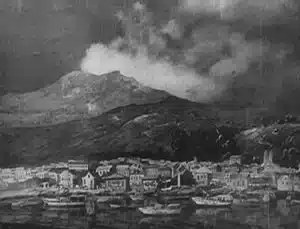
Within minutes, the city of Saint-Pierre, then nicknamed the “Little Paris of the Antilles,” was annihilated by the eruption of Montagne Pelée.
Nearly 30,000 people perished.
A prosperous city vanished.
A volcanic tragedy became one of the deadliest natural disasters of the 20th century.
Understanding the 1902 eruption in Martinique means grasping both the power of nature and the deep memory that still inhabits the island today.
What Happened on May 8, 1902?
The answer is: an extremely violent pyroclastic flow rushed down the slopes of the volcano and destroyed Saint-Pierre within minutes.
The Volcanic Phenomenon
Montagne Pelée showed signs of activity as early as April 1902:
Intense fumaroles
Ash falls
Mudflows (lahars)
Seismic tremors
Despite these alarming signals, the population of Saint-Pierre did not flee en masse.
On May 8, a pyroclastic flow — a burning cloud composed of gas, ash, and volcanic blocks at temperatures exceeding 1,000°C — surged forward at an estimated speed of more than 500 km/h.
In less than two minutes, the city was wiped off the map.


Why Was Saint-Pierre Not Evacuated?
This question still echoes through memory.
Several factors explain the absence of mass evacuation:
- Political Context
Legislative elections were scheduled just days later.
Authorities downplayed the danger to avoid panic.
- Limited Scientific Understanding
In 1902, volcanology was still in its infancy.
The concept of a pyroclastic flow was not clearly identified.
- Attachment to the City
Saint-Pierre was the economic and cultural heart of Martinique:
Theater
Cathedral
Major commercial port
Distilleries and trading houses
Leaving the city meant abandoning property, business, and future prospects.
The Survivors of the Catastrophe
It is estimated that only two to three people survived in the directly affected area.
The most famous was Louis-Auguste Cyparis, a prisoner protected by the thick walls of his cell. Severely burned, he survived miraculously.
His story traveled around the world.
The Consequences for Martinique
The 1902 eruption permanently transformed the island.
Human and Economic Impact
Nearly 30,000 deaths
The definitive decline of Saint-Pierre as the economic capital
Gradual transfer of activity to Fort-de-France
Global Scientific Impact
The disaster contributed to:
A better understanding of pyroclastic flows
The structuring of modern volcanology
The establishment of volcanic monitoring systems
Today, Montagne Pelée is one of the most studied volcanoes in the Caribbean.
Saint-Pierre Today: Memory and Renewal
Visiting Saint-Pierre in 2026 means walking through a city inhabited by history.
You can discover:
The ruins of the theater
The remains of the prison
The foundations of the cathedral
The Musée volcanologique Franck Perret
The city never fully recovered economically, yet it possesses a unique atmosphere — both peaceful and deeply marked by memory.
In summary: Saint-Pierre is not merely a historical site. It is a place of transmission.
Montagne Pelée Today: A Monitored Volcano
Inscribed as a UNESCO World Heritage Site in 2023 (together with the northern pitons), Montagne Pelée remains active but closely monitored.
Instruments continuously measure:
Seismic activity
Gas emissions
Ground deformation
Authorities now have effective alert protocols in place.
The 1902 catastrophe profoundly changed volcanic risk management in the region.
A Memory Inscribed in the Soul of the Island
The 1902 eruption in Martinique is not just a historical event.
It is a living memory.
It reminds us of the power of the elements.
The fragility of human certainty.
And the ability of an island to rise again.
Today, Martinique blends beauty, history, and resilience.
Between luminous beaches and volcanic landscapes, it carries within it this duality: gentleness and strength.


